The Night the North Sea Screamed: Piper Alpha and the Birth of the Barrier Mindset
The night Piper Alpha burned, the North Sea didn't just take 167 lives. It took away a comforting lie: the idea that big disasters come from one big mistake.
On July 6, 1988, a series of gas explosions turned the world's most productive oil platform into a towering inferno. In the aftermath, the story moved from the churning sea to the green benches of Westminster. What followed was a public autopsy of a system that had failed long before the first spark. It was the moment the industry realized that safety isn’t a status you achieve-it is a story of barriers you must constantly maintain.
Part I: The Ghost in the Bureaucracy
By autumn 1988, the grief had crystallized into paperwork. In a written answer to Parliament, the government began tracking the technical investigation and the funds authorized for the recovery. It looked like standard bureaucracy, but the tension was already rising.
Fast-forward to November 1990. The House of Commons is packed. Lord Cullen's inquiry report is on the table-all two volumes and 106 recommendations of it. The Energy Secretary stands to address the House, dropping the line that would become the new baseline for offshore safety:
“The primary responsibility for safety has always been, and will always remain, with the operator.”(Hansard, 1990)
The room felt the weight of that sentence. It wasn’t the government promising to be a guardian angel; it was the government telling the industry that accountability cannot be outsourced to regulators or “good intentions.” Cullen's conclusion was blunt: the old approach didn’t emphasize auditing how safety was managed. The villain wasn’t one broken valve or one tired worker-it was a systemic blindness to how hazards actually behave.
Part II: The Myth of the “Off-the-Peg” Solution
By December 1990, Parliament was circling a deeper, more uncomfortable theme. One MP, reflecting on a string of North Sea incidents, voiced the reality that safety isn’t solved by a binder of procedures. He noted that Cullen found safety “cannot be secured by fixed rules or off-the-peg solutions.” (Hansard, 1990)
This is where “Barrier Thinking” begins to make emotional sense. If rules aren’t enough, what is?
Imagine a dialogue in a smoke-filled room in Aberdeen or a corridor in Whitehall during the drafting of the 1992 Offshore Safety Bill:
MP: “My constituents are asking why a man was doused in acid and left for twelve hours before a helicopter was called. They want to know why we are still using rescue vessels built in the 1930s.”
Industry Rep: “We have procedures for medical evacuation. We follow the maritime codes.”
MP: “Your ‘procedures’ are a paper wall. A barrier only exists if it actually stops the harm. If the boat is too slow and the manager is too worried about the cost of stopping the drill to call the chopper, you don’t have a barrier. You have a gamble.” (Adapted from api.parliament.uk, 1992)
Frank Doran, MP for Aberdeen South, brought this “real world” grit to the floor, citing cases where operators weighed “the cost of stopping drilling against the cost of the extra insurance premium.” (api.parliament.uk, 1992). This highlighted the ultimate failure: when the system treats harm as a mere cost of doing business, every safety barrier eventually erodes.
Part III: Visualizing the Chain-The Rise of the Bowtie
The Cullen Report forced a transition from “complying with rules” to the “Safety Case” regime. Operators now had to demonstrate they understood their risks. This created a vacuum: how do you show a regulator-or a worker on a night shift-that a complex system is safe?
Enter the Bowtie Method.
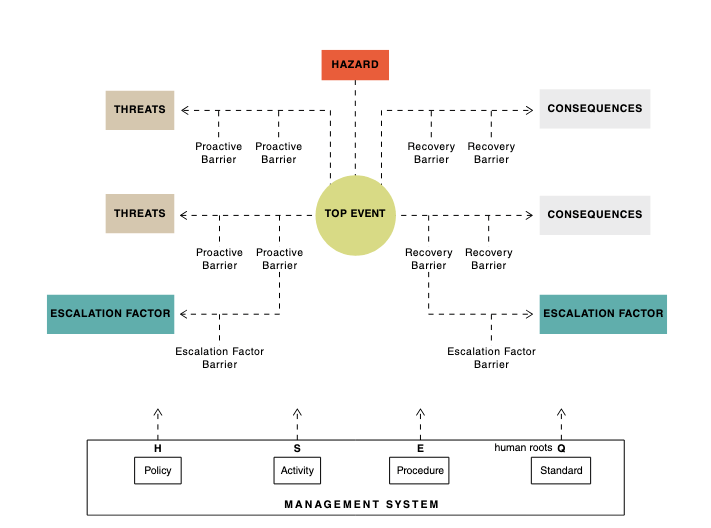
Originally a logic problem for aerospace and nuclear engineers, the Bowtie became the visual language of the post-Piper Alpha world. In the early 1990s, Royal Dutch Shell adopted it as a global standard. It wasn’t just a diagram; it was a story:
- The Knot (Center): The “Top Event”-the moment you lose control (e.g., a gas leak).
- The Left Wing: The threats that can cause that leak (corrosion, overpressure, impact).
- The Right Wing: The consequences if the leak happens (fire, explosion, loss of life).
- The Barriers: The “slices of cheese” placed on both sides to stop the threat or mitigate the damage.
The Bowtie turned the abstract arguments of Parliament into a tool for the rig floor. It allowed a supervisor to ask: “This valve is leaking-which part of my Bowtie just disappeared? Are the remaining barriers strong enough to keep us running?”
Part IV: Beyond the Poster
Today, barrier management is the “grown-up” version of safety. It's not a poster that says “Safety First.” It is a rigorous, almost boring process of asking:
- Who owns this specific barrier?
- What does “working” look like in measurable terms?
- What happens to the system when this barrier is bypassed to keep production moving?
Piper Alpha proved that disaster is a chain. Risk management is the art of breaking that chain, link by link, before the tension becomes unbearable. The legacy of 1988 isn’t just a set of regulations; it's the realization that the greatest hazard isn’t the gas or the pressure-it’s the belief that your protections are there when they aren’t.
As the industry moves toward more automated and connected systems, the “Cullen Logic” remains the North Star: Safety isn’t a promise. It's maintenance.